
Building a capability-driven future: OTP Bank Group’s journey toward core modernization
Future success in banking will not come from being future-proof, but from being future-agnostic— building the right capabilities, forging true partnerships, and staying humble enough to adapt.
About the bank
OTP Bank is a leading regional financial services provider with over 100 billion in assets, operating across diverse markets including Bulgaria, Slovenia, Uzbekistan, Ukraine, and Russia.Navigating complex geopolitical and regulatory environments, the bank prioritizes adaptable capabilities, human-centric technologies like its PULZE program, and future-agnostic design to deliver lovable and reliable digital solutions to millions of customers.
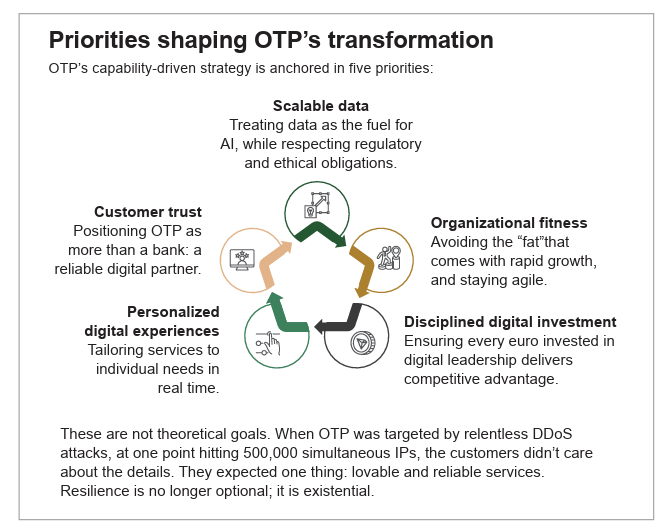
Banking today is defined by complexity. Institutions are forced to adapt to volatile geopolitical events, diverse regulatory environments, fast-changing customer expectations, and the relentless pace of digital disruption.These are not distant challenges; they are realities that shape day-to-day work at OTP Bank.OTP has grown into a regional leader with operations across multiple countries,including Ukraine and Russia. This expansion brings opportunity but also exposes us to crises ranging from war and sanctions to fragmented regulations and technological constraints.Within weeks, entire banking operations were migrated into the cloud, critical systems were replaced under sanctions,and large-scale cyberattacks were withstood. In facing these realities, one essential truth becomes clear: the future cannot be prepared for by predicting it.Instead, the focus must be on building capabilities, technological, organizational,and human, that allow navigation through whatever future unfolds.
Complexity as the Starting Point
OTP’s journey has been anything but simple. With over 100 billion in assets, operations now span a diverse set of markets: Bulgaria, Slovenia, Uzbekistan, Ukraine, Russia, and more. Each geography comes with its own regulations and restrictions. In some countries, for example, the cloud is outright forbidden. When the war in Ukraine broke out, Ukrainian operations were migrated into the cloud within three weeks.At the same time, sanctions necessitated a complete replacement of the technology stack in Russia. These experiences made one thing clear: a single, fixed vision of the “bank of the future” cannot be built. Instead, strategy must be rooted in adaptable capabilities.
Building a single, fixed vision of the bank of the future is impossible.Instead, strategy must be rooted in adaptable capabilities
The Strategy of Capabilities
The approach can be described as a “navigation system” strategy. Just as drivers today rely on Waze or Google Maps to dynamically adjust routes, capabilities are built across technology, processes, architecture, and people, allowing multiple paths to the same
Destination.To bring this to life, the OKR (Objectives and Key Results) methodology was adopted. Emotion was also deliberately embedded into the vision: “to create lovable and reliable digital solutions for everyone.”The word “lovable” was not chosen lightly. Inspired by Rachel Botsman’s research on trust, it became evident that unless a solution is both lovable and reliable, customers will not use it.
If something is not lovable and not reliable, customers will not trust it. And without trust, they will not use it
People at the Core
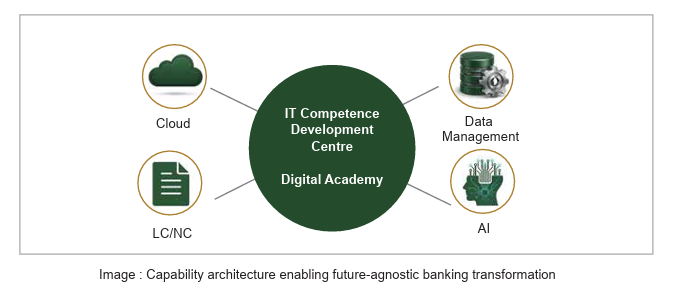
Technology is vital, but transformation cannot succeed without people. This led to the launch of PULZE —a program to train all 40,000 of our employees in four transformational digital capabilities: cloud, low-code/ no-code, data, and AI. Every employee can “level up” depending on their current knowledge level, from awareness, to application, to mastery, with managers receiving an additional leadership focused journey. Over 5,000 colleagues have already completed the fundamentals. AI, in particular, has reshaped thinking. Three years ago, a partnership was formed with California-based SambaNova to build one of the largest Hungarian
English language models. The true outcome, however, was not the model itself, but the institutional knowledge gained: understanding what to build, what to buy, and how AI reshapes organizational design.
The biggest outcome of our AI journey was not the model itself but the knowledge of what to build, what to buy, and what not to do
Modernizing the Core:
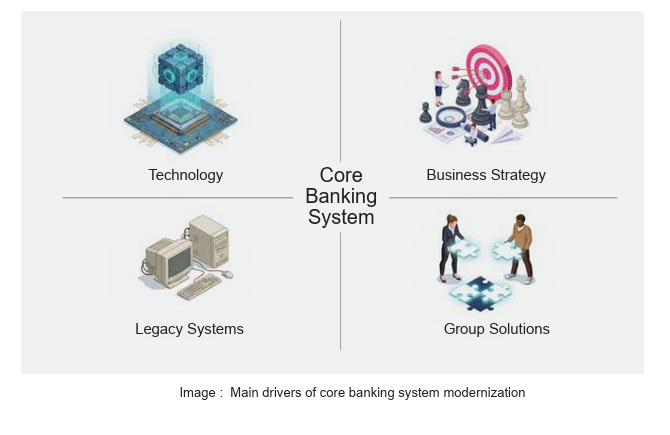
complete when the core is modernized. While OTP’s current system has served the organization well, its legacy technology and sustainability challenges now pose strategic risks. A hybrid approach was adopted: a centralized core provided by a solution partner, combined with selective modules we develop in house to preserve competitiveness. This balances group-wide standardization with local flexibility. During evaluation, it quickly became evident that no vendor
could offer both cutting-edge technology and full functionality. The right question, then, was not “Which vendor?” but “Which partner?” Ultimately, OTP chose Intellect Design Arena, because partnership matters more than features. Modernization is never seamless, but with a partner, responsibility is shared.
For core modernization, you don’t need a vendor, you need a partner
Future-Agnostic, Not Future-Proof
The phrase “future-proof” is deliberately avoided at OTP. It implies rigidity, an immovable monolith. Instead, the belief is in future-agnostic design: architectures that can change quickly, partnerships that can flex, and capabilities that adapt continuously. Remaining competitive means asking the right questions, investing wisely, and remaining humble. Large transformations demand openness, a willingness to learn from mistakes, and the discipline to keep moving forward.
Future-agnostic design is not just about technology; it is a way of thinking
Lessons for the Industry:
This journey at OTP bank offers several lessons for peers across the industry: Focus on capabilities, not predictions. The future cannot be forecast, but capabilities can prepare us for any scenario. Trust is the currency of digital banking. Lovable and reliable solutions are essential. Empower people alongside technology. Skills programs like PULZE are crucial. Seek partners, not vendors. Core modernization requires collaboration, not procurement. Embrace agility as resilience. Future-agnostic thinking is the only way to survive shocks and seize opportunities
-
- Focus on capabilities, not predictions. The future cannot be forecast, but capabilities can prepare us for any scenario.
-
- Trust is the currency of digital banking. Lovable and reliable solutions are essential.
-
- Empower people alongside technology. Skills programs like PULZE are crucial.
-
- Seek partners, not vendors. Core modernization requires collaboration, not procurement.
-
- Embrace agility as resilience. Future-agnostic thinking is the only way to survive shocks and seize opportunities
Closing Reflection
At the end of the day, transformation in banking is not about technology alone. It is about the capabilities we build, the partners we trust, and the humility with which we face the unknown. Competitive advantage will come not from rigid plans, but from the ability to ask the right questions and adapt quickly to new answers. Data Management IT Competence Development Centre Digital Academy AI transformations demand it. Humility keeps us open to change, disciplined enough to learn from mistakes, and resilient enough to keep our speed when the world around us is shifting. The final message is simple: remain humble. Large-scale transformations demand it. Humility keeps us open to change, disciplined enough to learn from mistakes, and resilient enough to keep our speed when the world around us is shifting.
Capability building, true partnership, relentless innovation, and above all, humbleness, are the only ways to navigate a world where the future cannot be predicted, only prepared for
Author:

Mr. Zoltán Kaszás,
MD - Group Digital Directorate,
OTP Bank Group
Share


