
Reimagining transformation using business impact AI
“In banking, AI that cannot be explained cannot be deployed.” Learn why trust, ethics, and explainability are the true currencies of enterprise-grade AI.
From Experiments to Enterprise-Grade AI
Artificial Intelligence has moved from research labs and innovation sandboxes to boardroom priorities. Yet, too often, financial institutions fall into the “pilot trap”—running isolated AI experiments that never scale into production. The panel emphasized that true
transformation requires reframing AI not as a shiny experiment, but as a business impact model aligned with compliance, ethics, and customer trust.ial clients affect the bank’s own wholesale funding needs? By linking borrowings directly to trade signals, Treasurers can lock in rates before the market prices in the next inflationary wave.
The AI journey must begin with clarity of purpose: which business outcomes matter, and how delivers them
Responsible AI in Regulated Environments
Banks operate under some of the world’s most stringent regulatory regimes. For Villanueva, this makes responsible AI not just a best practice, but an existential necessity. Trust must be engineered into every layer of AI—from data sourcing and training to model deployment and customer interaction.
Ethical considerations are inseparable from compliance. Bias in lending, opaque decisionmaking, or unchecked surveillance could erode the very trust banks are built on. As Martinez noted, financial services cannot afford a “move fast and break things” mindset. Instead, responsible AI frameworks must prioritize explainability, accountability, and auditability.
In banking, AI that cannot be explained cannot be deployed
Scaling Without Breaking
Both panelists highlighted a paradox: AI innovation must be agile, but banking infrastructure cannot afford fragility. The solution lies in layered governance models—frameworks that allow institutions to experiment quickly while ensuring that production systems remain stable, secure, and compliant.
For RCBC, AI has been deployed in areas like financial inclusion and customer engagement, where trust and accessibility drive adoption. For Revolut, with its digital-first DNA, the challenge lies in governing rapid scaling across multiple jurisdictions, each with its own regulatory expectations. Both examples reinforce the need for scalable, adaptable AI governance.
Agility without governance is chaos; governance without agility is stagnation. Successful AI demands both
Business Outcomes First
The panelists agreed that AI adoption must be anchored to measurable business outcomes.Whether reducing fraud, enhancing customer onboarding, or driving personalized financial advice, every AI initiative must answer the question: what business value does this create? Felipe stressed that framing AI as a productivity tool alone undersells its potential. Done right, AI can reshape how banks operate at their core—driving new products, unlocking financial access, and transforming customer experience. But success requires constant alignment between AI roadmaps and organizational strategy.
AI should not be a science project. It must be a business strategy
Lessons From the Panel Several lessons emerged from the discussion:
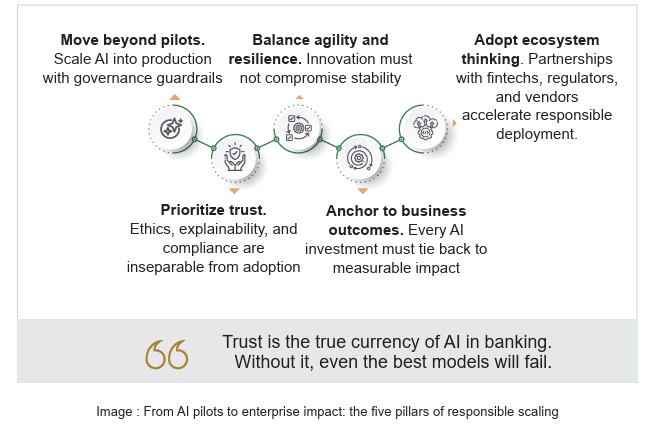
- Move beyond pilots. Scale AI into production with governance guardrails
- Prioritize trust. Ethics, explainability, and compliance are inseparable from adoption
- Balance agility and resilience. Innovation must not compromise stability
- Anchor to business outcomes. Every AI investment must tie back to measurable impact
- Adopt ecosystem thinking. Partnerships with fintechs, regulators, and vendors accelerate responsible deployment
Closing Reflection
AI in banking is no longer optional—it is inevitable. But its future will not be shaped by hype cycles or pilot projects. It will be shaped by how well banks align AI to business outcomes, scale responsibly, and govern ethically. The panel made one point abundantly clear: the banks that win will be those that deploy AI with purpose, discipline, and humility. Not chasing every breakthrough, but embedding the right capabilities that deliver real, trusted value.
The measure of AI success is not how advanced the model is, but how much trusted impact it creates.
Authors:

Deepak Dastrala,
Chief Technology Officer,
IntellectAI

Lito Villanueva,
Chief Innovation & Inclusion Officer,
RCBC

Felipe Penacoba,
Chief Information Officer,
Revolut
Share


